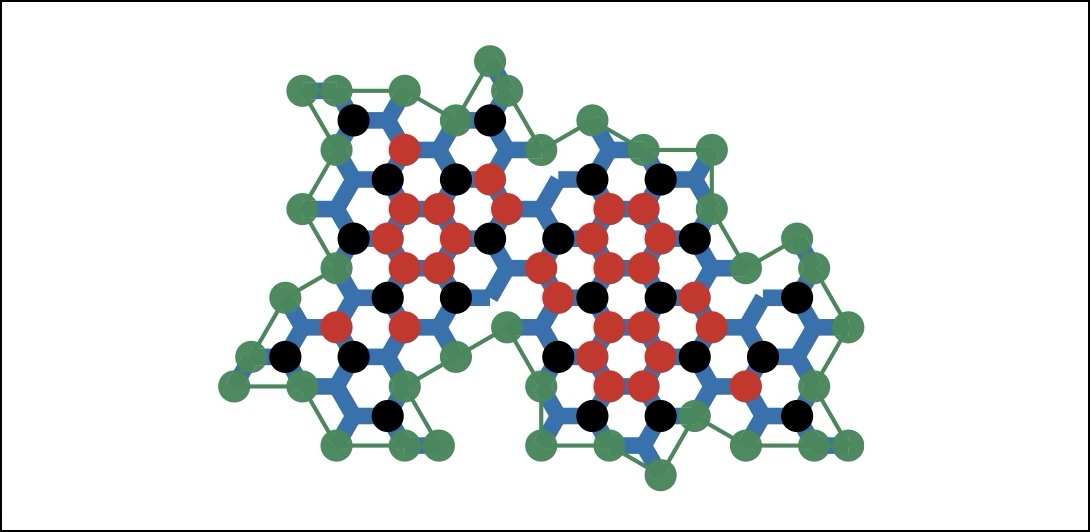
An important example of protein self-assembly in cells is clathrin-mediated endocytosis (CME), in which a protein lattice composed of clathrin molecules self-assembles on the cytosolic side of the cell membrane and subsequently invaginates together with the membrane. I developed analytical and computational models to study the self-assembly of flat clathrin-lattices (Frey et al., 2020), the invagination of the composite of clathrin lattice and lipid membrane (Frey & Schwarz, 2020), (Frey & Schwarz, 2024), and collaborated on this topic with the Ries lab (Max Perutz Labs, University of Vienna) (Mund et al., 2023) and the Boulant lab (University of Florida) (Bucher* et al., 2018).
References
2024
-
Coat stiffening can explain invagination of clathrin-coated membranes
Felix Frey , and Ulrich S. Schwarz
Phys. Rev. E, Dec 2024
Clathrin-mediated endocytosis is the main pathway used by eukaryotic cells to take up extracellular material, but the dominant physical mechanisms driving this process are still elusive. Recently, several high-resolution imaging techniques have been used on different cell lines to measure the geometrical properties of clathrin-coated pits over their whole lifetime. Here, we first show that the combination of all datasets with the recently introduced cooperative curvature model defines a consensus pathway, which is characterized by a flat-to-curved transition at finite area, followed by linear growth and subsequent saturation of curvature. We then apply an energetic model for the composite of the plasma membrane and clathrin coat to this consensus pathway to show that the dominant mechanism for invagination could be coat stiffening, which might originate from cooperative interactions between the different clathrin molecules and progressively drives the system toward its intrinsic curvature. Our theory predicts that two length scales determine the invagination pathway, namely the patch size at which the flat-to-curved transition occurs and the final pit radius.
2023
-
Clathrin coats partially preassemble and subsequently bend during endocytosis
Markus Mund , Aline Tschanz , Yu-Le Wu , Felix Frey , and 5 more authors
J. Cell Biol., Mar 2023
Eukaryotic cells use clathrin-mediated endocytosis to take up a large range of extracellular cargo. During endocytosis, a clathrin coat forms on the plasma membrane, but it remains controversial when and how it is remodeled into a spherical vesicle. Here, we use 3D superresolution microscopy to determine the precise geometry of the clathrin coat at large numbers of endocytic sites. Through pseudo-temporal sorting, we determine the average trajectory of clathrin remodeling during endocytosis. We find that clathrin coats assemble first on flat membranes to 50% of the coat area before they become rapidly and continuously bent, and this mechanism is confirmed in three cell lines. We introduce the cooperative curvature model, which is based on positive feedback for curvature generation. It accurately describes the measured shapes and dynamics of the clathrin coat and could represent a general mechanism for clathrin coat remodeling on the plasma membrane.
2020
-
Eden growth models for flat clathrin lattices with vacancies
Felix Frey , Delia Bucher , Kem A Sochacki , Justin W Taraska , and 2 more authors
New J. Phys., Jul 2020
Clathrin-mediated endocytosis is one of the major pathways by which cells internalise cargo molecules. Recently it has been shown that clathrin triskelia can first assemble as flat lattices before the membrane starts to bend. However, for fully assembled clathrin lattices high energetic and topological barriers exist for the flat-to-curved transition. Here we explore the possibility that flat clathrin lattices grow with vacancies that are not visible in traditional imaging techniques but would lower these barriers. We identify the Eden model for cluster growth as the most appropriate modeling framework and systematically derive the four possible variants that result from the specific architecture of the clathrin triskelion. Our computer simulations show that the different models lead to clear differences in the statistical distributions of cluster shapes and densities. Experimental results from electron microscopy and correlative light microscopy provide first indications for the model variants with a moderate level of lattice vacancies.
-
Competing pathways for the invagination of clathrin-coated membranes
Felix Frey , and Ulrich S. Schwarz
Soft Matter, Oct 2020
Clathrin-mediated endocytosis is the major pathway by which eukaryotic cells take up extracellular material, but it is still elusive which physical pathways are being taken during membrane invagination. From a continuum point of view, it can be driven by increases in coat stiffness, preferred curvature or line tension. Here we develop a comprehensive theoretical framework that can be solved analytically and that predicts the consequences of these different scenarios. We find that for the case of increasing stiffness or preferred curvature, curvature will be acquired gradually with growth, while for increasing line tension, the lattice must have grown to a certain size before a flat-to-curved transition can occur. At low membrane tension, the critical value for coat stiffness is 30 kBT, for preferred curvature it is 200 nm, and for line tension it is 6 pN. For high membrane tension, critical coat stiffness is 150 kBT and critical preferred curvature is 70 nm. In the mixed case when a coat with finite rigidity but increasing line tension is considered, a cup-to-sphere transition can occur for a line tension of 6 pN. The flat-to-curved and the cup-to-sphere transitions driven by line tension are both suppressed by high membrane tension.
2018
-
Clathrin-adaptor ratio and membrane tension regulate the flat-to-curved transition of the clathrin coat during endocytosis
Delia Bucher* , Felix Frey* , Kem A. Sochacki , Susann Kummer , and 7 more authors
Nat. Commun., Mar 2018
*contributed equally
Although essential for many cellular processes, the sequence of structural and molecular events during clathrin-mediated endocytosis remains elusive. While it was long believed that clathrin-coated pits grow with a constant curvature, it was recently suggested that clathrin first assembles to form flat structures that then bend while maintaining a constant surface area. Here, we combine correlative electron and light microscopy and mathematical growth laws to study the ultrastructural rearrangements of the clathrin coat during endocytosis in BSC-1 mammalian cells. We confirm that clathrin coats initially grow flat and demonstrate that curvature begins when around 70% of the final clathrin content is acquired. We find that this transition is marked by a change in the clathrin to clathrin-adaptor protein AP2 ratio and that membrane tension suppresses this transition. Our results support the notion that BSC-1 mammalian cells dynamically regulate the flat-to-curved transition in clathrin-mediated endocytosis by both biochemical and mechanical factors.